August 17, 2026
Evidence That Helps Us Learn, Not Just Perform
By Olivia Odileke
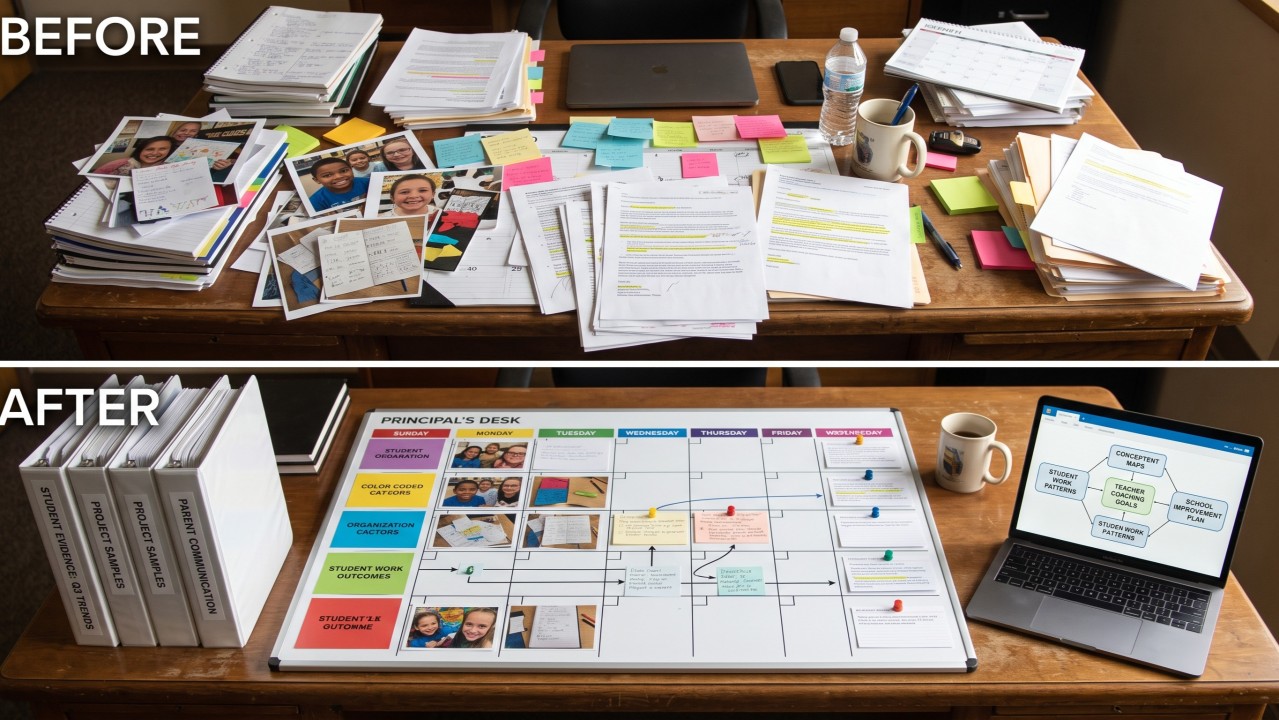
You're in your third week of classroom visits. You're watching teachers try new things. You're seeing student thinking shift. You're collecting evidence.
But where is it?
One observation is in your notebook. You sent an email to a teacher about something you noticed. You took a photo of student work. You have notes from a coaching conversation. Another teacher sent you student writing samples. You saw purposeful learning happening and wrote it on a sticky note.
You're drowning in evidence. And you're not seeing the pattern.
What the Research Says About Evidence
Here's what matters: Not all evidence helps you learn. Some evidence just helps you perform. Helps you report. Helps you fill out the form at the end of the year.
Evidence that helps you learn is connected. It's evidence that helps you see: When we did this, that happened. When we tried that, teachers responded this way. When we collected this evidence, we noticed this pattern.
Evidence that helps you perform is isolated. It's snapshots. It's data points. It's not connected to anything.
The difference is connection.
Imagine This Scenario
You're doing coaching cycles with three teachers. Each one is trying something new. Each one is teaching differently. Each one is creating more purposeful learning.
But it's happening in isolation. Teacher A is trying open ended questions. Teacher B is using student discourse. Teacher C is doing problem based learning. All three are creating deeper thinking. But you can't see how they're connected. You can't see that all three are moving toward the same vision. You can't show them to each other what's working.
So you collect the evidence separately:
- Teacher A: Notes from observation. Student responses showing deeper thinking.
- Teacher B: Recording of classroom discussion. Notes on how students engaged.
- Teacher C: Student work samples. Reflection on problem solving.
It's evidence. Good evidence. But it's separate.
Now imagine if it was connected. If you could see:
- Coach observed purposeful questioning (Teacher A)
- Coach observed student discourse deepening understanding (Teacher B)
- Coach observed problem solving creating ownership (Teacher C)
- All three happened in the same week
- All three are moving toward our vision of purposeful learning
- All three are part of our collaborative improvement cycle
Suddenly the evidence isn't just good. It's powerful. It shows pattern. It shows progress. It shows collaborative improvement cycles actually happening.
The Missing Piece
Most schools collect evidence. They're drowning in it. Observation notes. Student work. Teacher reflections. Assessment data. Video. Photos.
What's missing is the system that connects the evidence to the cycles. That shows: This coaching moved this teacher's practice. This reflection led to this iteration. This evidence shows this team is moving toward the vision.
Without that system, evidence helps you perform. You report what happened. You fill out forms. You submit data.
With that system, evidence helps you learn. You see patterns. You see progress. You see collaborative improvement cycles creating change.
Why This Matters Right Now
You're three weeks in. You're coaching. You're collecting evidence. You're starting to see improvement cycles.
The question is: Can you see them? Can you show your teachers? Can you demonstrate to your team that the work is working?
If the evidence is scattered, you can't. You know it's happening. But you can't show it. You can't make it visible.
If the evidence is connected, you can. You can show teachers: Look at these three classrooms. All moving toward purposeful learning. All part of our collaborative cycle. All supported by coaching and reflection. This is working.
That visibility changes everything. It builds momentum. It shows teachers they're not alone. It shows progress.
The Leadership Move
The move is connecting the evidence. Stop collecting it in isolation. Start collecting it in a way that shows the improvement cycles.
Ask yourself: What evidence would help my team see that we're moving together toward our vision? How would that evidence need to be organized to show connection? What system would make that visible?
That's the system you're looking for.
The Leadership Pause
Think about the evidence you're collecting right now. Your coaching notes. Student work. Teacher reflections. Observations.
Is it helping you perform? Or is it helping you learn?
Can you see your collaborative improvement cycles? Or are they invisible?
Learn more in Chapter 9 of The Question-Driven Principal: Leading Instructional Improvement Without Being the Content Expert
Further Reading:
Bryk, A. S., Gomez, L. M., Grunow, A., & LeMahieu, P. G. (2015). Learning to Improve: How America's Schools Can Get Better at Getting Better. Harvard Education Press. Bryk and colleagues demonstrate that improvement requires evidence that's connected to cycles of action and reflection. Isolated data points don't create learning. Connected evidence that shows cause and effect creates improvement.
Schmoker, M. J. (2004). Tipping Point: From Feckless Reform to Substantive Instructional Improvement. Phi Delta Kappan, 85(6), 424 to 432. Schmoker's research shows that schools that see improvement connect their evidence to collaborative cycles. Evidence that helps teams see patterns and progress drives sustainable change. Evidence that just fills reports doesn't.
See the Difference in 90 Days
You're collecting evidence. You're coaching. You're seeing improvement cycles happen.
What if you could see them connected?
LEAD Spark Team connects your coaching observations, student evidence, teacher reflections, and team learning into collaborative improvement cycles. You and your teachers can see what's actually working. You can show progress. You can sustain momentum.
Try the 90-Day Pilot for $1,400. One click to start at app.leadsparkteam.com. No PO delays. Just visibility. Just collaborative improvement cycles made visible.
Your teachers will see what's possible. You'll see that the only thing missing was a system that connects everything together.
Lead Spark Team
See where your improvement process is actually breaking
In 30 minutes, look at what is working in your school, where walkthroughs and PLCs stop changing practice, and what one focused cycle would look like. No credit card. No prep required.