April 27, 2026
Questions That Open Thinking vs. Questions That Shut It Down
By Olivia Odileke
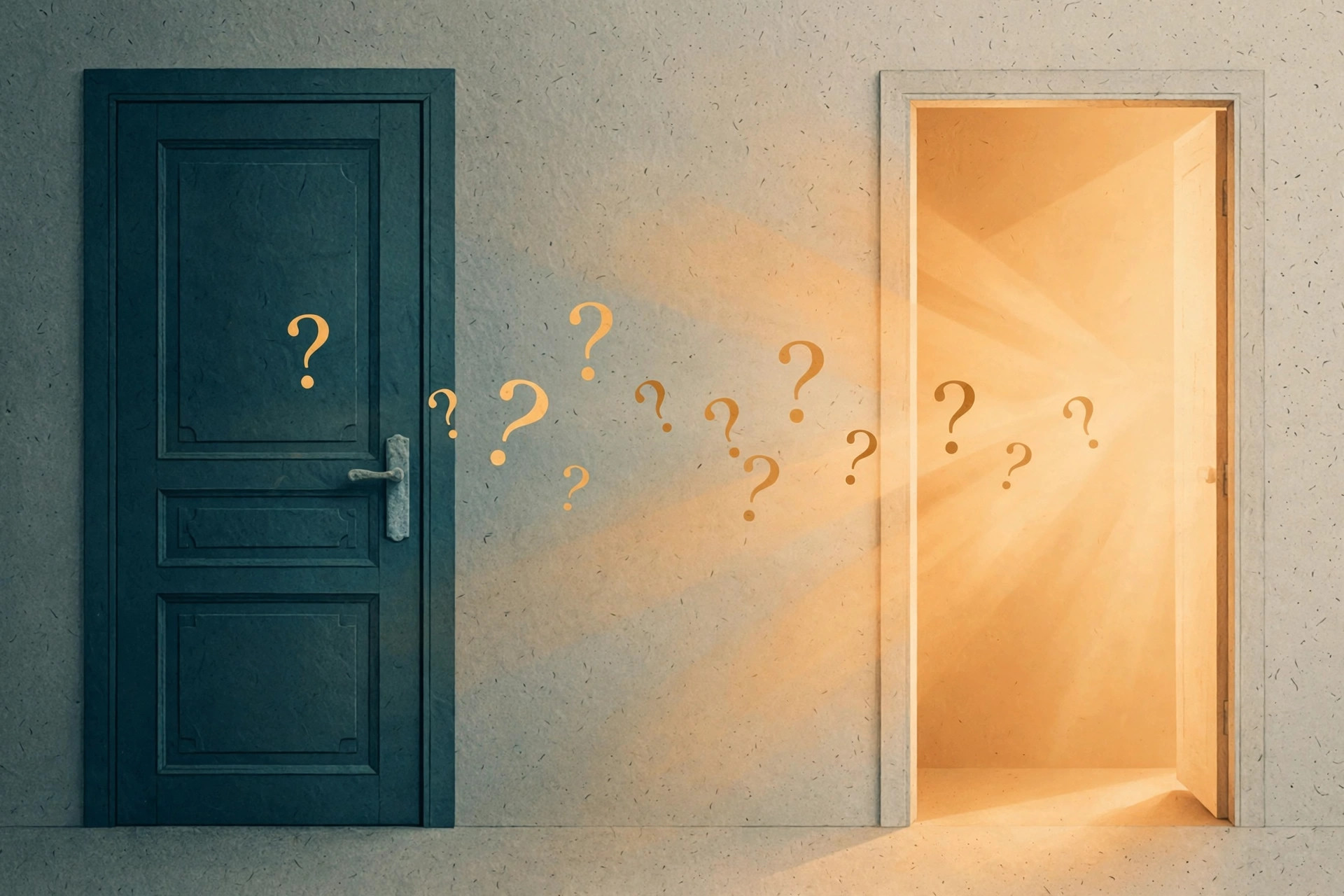
Not all questions are created equal.
Some questions open minds. They make people think. They invite multiple perspectives. They create space for wonder.
Other questions close minds. They masquerade as questions but they're really statements. They guide people toward a conclusion. They shut down thinking by making the answer seem obvious.
A teacher is explaining a concept. A student looks confused. The teacher asks: "You understand that, right?"
That's not a question. That's a statement wrapped in question marks. The teacher has already decided the student understands. The "question" is just looking for confirmation.
Now imagine: "I'm noticing you're not nodding. What's confusing about what I just said?"
That's a real question. It's open. It invites the student to think and speak.
The difference is subtle. But it changes everything about what happens next.
The Questions That Close
Closed questions usually have a few characteristics. They guide toward a predetermined answer. They sound like questions but they're really statements. They make the asker's assumption visible.
"Don't you think that's the right approach?" (The asker already thinks it's right.)
"That's a good example of characterization, isn't it?" (The asker has decided it's good.)
"You understand how to solve this, right?" (The asker assumes the student understands.)
These aren't invitations to think. They're invitations to agree.
And when students or teachers feel like they're being asked to agree with something, they either agree (compliance) or disagree (resistance). Either way, they stop thinking.
The Questions That Open
Open questions don't have a predetermined answer. They invite thinking. They signal genuine curiosity.
"What's confusing about what I just explained?"
"What do you notice about this example?"
"How would you solve this?"
"Why do you think that's true?"
These questions do something different. They say: I'm genuinely curious about your thinking. I don't know what you're going to say. But I want to hear it.
And when people feel genuinely curious about, they think. They speak. They offer their real thinking, not just what they think the questioner wants to hear.
How This Shows Up in Leadership
A principal talks with a teacher after a lesson. She could ask: "That lesson went well, don't you think?"
Or she could ask: "What did you notice about how students responded to that task?"
In the first, the teacher senses the principal's judgment and either agrees or defends. Thinking stops.
In the second, the teacher has room to think and reflect. The principal is genuinely curious about what the teacher noticed.
One creates compliance. The other creates thinking.
Building Awareness of Question Quality
Most leaders don't realize the questions they ask are closed. They think they're opening conversation. But the question has steered toward their conclusion.
Building awareness is the first step. Next time you ask a question, pause and ask yourself: "Do I already know how I want this answer to turn out?"
If yes, it's probably a closed question.
If no, if you're genuinely open to any answer, it's probably open.
Questions That Genuinely Move Thinking Forward
The most powerful questions are ones where:
- You don't know the answer in advance
- Multiple answers are actually possible
- The question invites the person to do intellectual work
- The question signals genuine curiosity about the other person's thinking
"What would happen if...?"
"What patterns are you noticing?"
"How are you thinking about this?"
"What would change if...?"
"Tell me more about..."
These questions require thinking. They can't be answered with quick agreement or disagreement. They invite genuine reflection.
The Leadership Move
The move is building awareness first. Then practice. Ask a question. Then wait. Really listen to the answer. Let your curiosity be genuine.
It sounds simple. But it requires slowing down. It requires letting go of knowing where the conversation should go. It requires trusting that good thinking will emerge if you genuinely ask and listen.
The Leadership Pause
The next time you ask a question, pause after you ask it.
Are you genuinely curious about the answer? Or do you already know how you want the person to respond?
If you're genuinely curious, you've asked an open question. If you already know the answer you want, you've probably asked a closed question masquerading as open.
The difference changes everything about what people feel safe thinking and saying.
Further Reading:
Brown, B. (2018). Dare to Lead: Brave Work to Change Your Life. Random House. Brown's research on leadership vulnerability shows that leaders who ask genuine questions (rather than questions designed to guide people toward predetermined conclusions) create cultures where people think critically and offer their authentic perspectives. She argues that leaders who are comfortable not knowing the answer create space for real thinking.
Boaler, J. (2015). Mathematical Mindsets: Unleashing Students' Potential Through Creative Math, Inspiring Messages and Innovative Teaching. Jossey Bass. Boaler's research on mathematical thinking demonstrates that open ended questions that invite multiple approaches and perspectives develop deeper mathematical reasoning and understanding. Closed questions that guide toward one "right" method limit thinking and create anxiety.
Lead Spark Team
See where your improvement process is actually breaking
In 30 minutes, look at what is working in your school, where walkthroughs and PLCs stop changing practice, and what one focused cycle would look like. No credit card. No prep required.