September 7, 2026
Turning Evidence Into Insight
By Olivia Odileke
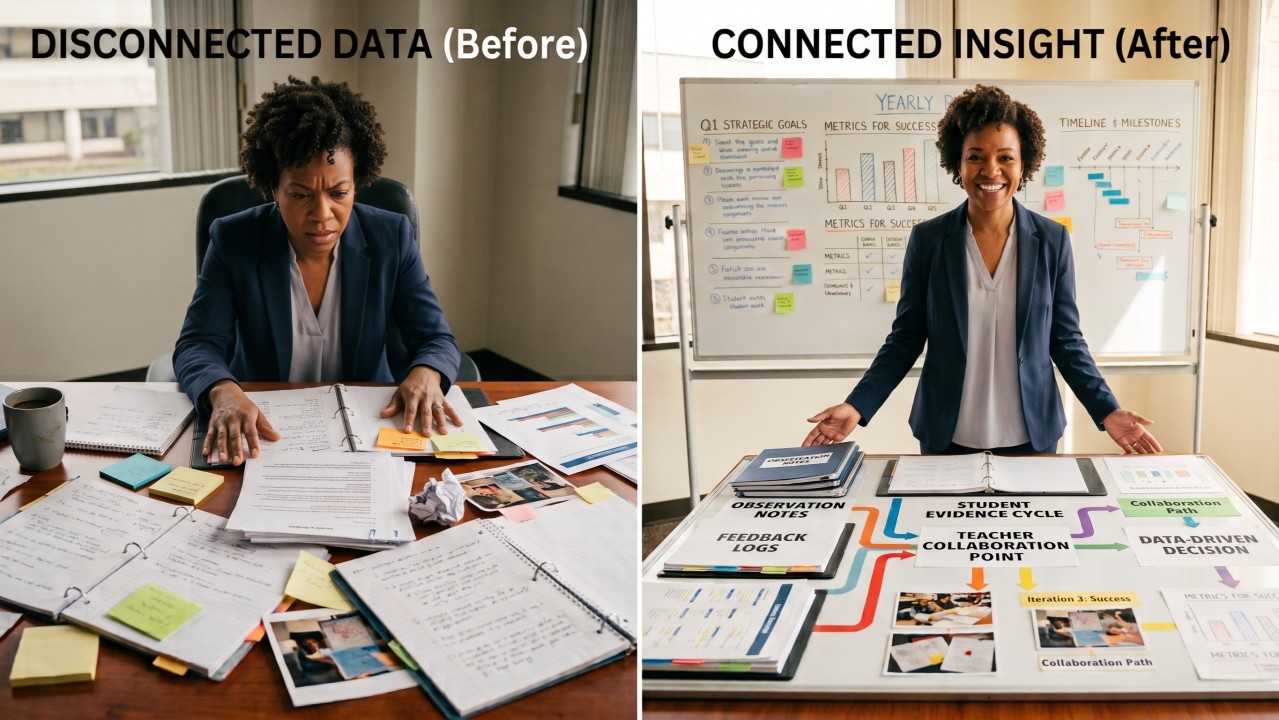
You're sitting with a stack of data. Student assessment results. Observation notes from twenty classrooms. Teacher reflections. Student work samples. Video of lessons. Coaching conversation notes.
You have evidence. Lots of evidence.
But you don't have insight.
You know something is changing. You can feel it. But you can't quite see it. You can't draw a line from the coaching you're doing to the shifts in teaching to the changes in student thinking. The evidence doesn't connect into a story.
The Difference Between Evidence and Insight
Evidence is data. It's observations. It's student work. It's what happened.
Insight is what it means. It's the pattern. It's the connection. It's the story of what happened and why.
Most schools have plenty of evidence and very little insight. They collect data. They look at results. But they don't see the pattern. They don't see how their collaborative cycles are creating change.
Imagine This Scenario
You have evidence:
- Your coaching notes show teachers trying open ended questions
- Student work shows more elaborate thinking
- Teacher reflections show they're seeing shifts
- Assessment data shows improvement
You have all the pieces. But you can't see the story. You can't say: "Here's what happened. We coached teachers on questioning. They tried it. Students thought more deeply. Results improved. That's the story."
The evidence is disconnected. It's just data points. You can't show it to your team and say: Look. This is our collaborative improvement cycle creating change.
Now imagine if you could see it connected. If you could draw a line:
- We designed a collaborative improvement cycle around purposeful questioning
- We coached teachers on the strategy
- We collected evidence from classrooms
- We reflected together on what we noticed
- We adjusted and tried again
- We looked at the results
That's not just evidence. That's insight. That's the story of how collaborative improvement works.
Why Insight Changes Everything
When you have insight, everything changes. You can see that your work is working. You can show your teachers. You can celebrate the wins. You can keep going.
When you don't have insight, you're flying blind. You have data. But you don't see progress. You don't see the connection. You feel like you're guessing.
Insight is what turns evidence into understanding. It's what makes collaborative improvement visible.
Imagine This Scenario
It's the end of September. You're reflecting with your leadership team. You have stacks of evidence. Coaching notes. Student work. Reflections. Data.
If you're just looking at evidence, you say: "We did some coaching. We collected some data. We'll see if it works."
If you have insight, you say: "Look at this. We designed a collaborative improvement cycle. Teachers practiced purposeful questioning. Look at the evidence. Students are thinking more deeply. Look at teacher reflections. They're seeing shifts. Look at the data. It's moving. This is working. This is what collaborative improvement looks like."
The second is powerful. It's not just evidence. It's a story. It's insight. It's understanding.
The Leadership Move
The move is connecting evidence into insight. Stop collecting data in isolation. Start collecting it in a way that shows your collaborative improvement cycles.
Ask yourself: If I could see all of my evidence connected—coaching cycles, evidence of student thinking, teacher reflection, team learning, results—what story would it tell?
That story is your insight. That's what keeps momentum alive.
The Leadership Pause
Think about the evidence you have right now. Can you see your collaborative improvement cycles? Can you draw a line from the coaching you're doing to the shifts happening to the results you're seeing?
Or is the evidence disconnected?
That's the insight you need. That's what changes culture.
Learn more in Chapter 9 of The Question-Driven Principal: Leading Instructional Improvement Without Being the Content Expert
Further Reading:
Bryk, A. S., Gomez, L. M., Grunow, A., & LeMahieu, P. G. (2015). Learning to Improve: How America's Schools Can Get Better at Getting Better. Harvard Education Press. Bryk and colleagues show that schools that improve connect evidence to cycles of action and learning. The insight comes when evidence is connected to the cycles, showing how improvement actually happens.
Guthrie, J. E., Seifert, K., & Prompte, L. (2014). From Data to Insights to Action. Educational Researcher, 41(4), 129 to 137. This research demonstrates that data becomes actionable when it's organized into narratives that show cause and effect, progress toward goals, and the impact of collaborative cycles.
See the Difference in 90 Days
You have evidence scattered across notebooks, emails, spreadsheets, and photos. And you can't see the story.
What if your evidence was connected? What if you could see your collaborative improvement cycles? What if the data told the story of how your coaching is creating change?
LEAD Spark Team connects your evidence into insight. It shows your collaborative cycles. It tells the story of improvement happening. It helps you see what's actually working.
Try the 90-Day Pilot for $1,400. Start at app.leadsparkteam.com. One click. No waiting. See the difference in 90 days.
Your evidence won't just be data. It will be insight. It will be the story of your collaborative improvement cycles creating change.
Reflective Questions for Weeks 33 through 36
As you move through this month of making collaborative improvement visible, consider:
- What evidence are you collecting right now? Is it connected or scattered?
- Can you see your collaborative improvement cycles? Can your teachers see them?
- Is reflection in your school individual or collaborative? Does it lead anywhere?
- Are teachers iterating? Can you see the iteration? Do they see it?
- Can you draw a line from your coaching to shifts in practice to changes in student thinking?
- What system would help you see all of this connected?
A Closing Mantra for September
The collaborative improvement cycles are already happening in your school. Your coaching is working. Your teachers are shifting. Your students are thinking more deeply. The only thing missing is the system that connects it all and makes it visible. That system is what sustains momentum. That system is what transforms culture.
LEAD Spark Team is that system. And it's waiting for you to say yes.
One More Thing
You don't need to be perfect to start. You don't need to have it all figured out. You don't need approval or a purchase order or months of planning.
You need one decision. And one click.
Try the 90-Day Pilot for $1,400. Bring your leadership team. Start tracking your collaborative improvement cycles. See what becomes visible. See what's possible.
Go to app.leadsparkteam.com. Purchase right now. No waiting. No delays.
In 90 days, you'll see the difference. Your collaborative improvement cycles will be visible. Your teachers will see progress. Your culture will shift.
That's what we're offering. That's what you're worth.
Lead Spark Team
See where your improvement process is actually breaking
In 30 minutes, look at what is working in your school, where walkthroughs and PLCs stop changing practice, and what one focused cycle would look like. No credit card. No prep required.