August 31, 2026
Why Iteration Beats Perfection
By Olivia Odileke
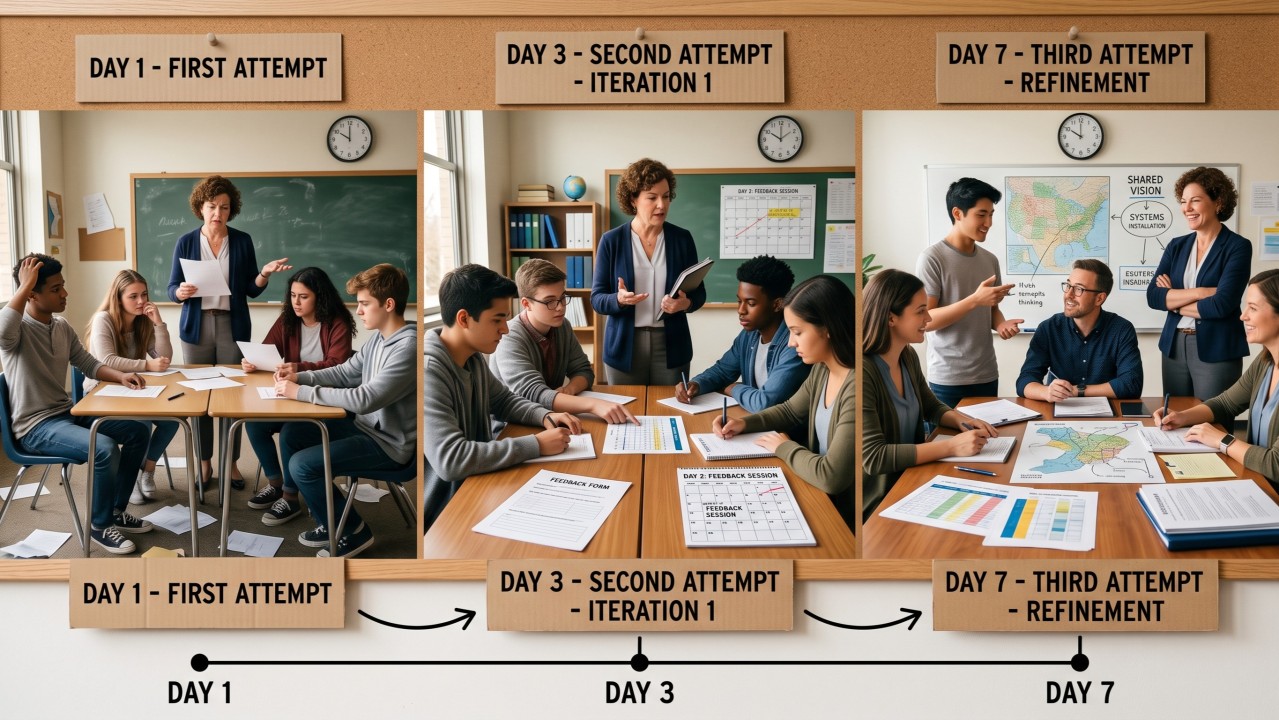
You're working with a teacher on deeper questioning. She tries it Monday. It's awkward. Students don't know how to respond. She feels like it didn't work.
She tries again Wednesday. Better. But still not where she wants it.
She tries again Friday. Progress.
She tries next Monday. It's becoming natural.
She's iterating. She's trying, noticing, adjusting, trying again. And it's working.
But here's the problem: Nobody can see the iteration. She's doing the cycles. But they're invisible.
Why Iteration Matters
Perfection is a myth. Teachers don't become great by getting it right the first time. They become great through iteration. Through trying something. Noticing what happened. Adjusting. Trying again. Doing it again. And again.
That's how change actually happens. Not through one great lesson. Through cycles of practice and refinement.
But here's what most schools miss: We can't see the iteration. We see the lesson. We see the result. But we can't see the cycles of trying and refining that created the result.
So improvement feels invisible. Teachers don't see their own progress. Teams don't see teammates iterating. Leaders can't point to the cycles and say: This is how we improve.
Imagine This Scenario
You're working with three teachers on purposeful learning. Each one is iterating. Each one is trying, adjusting, trying again.
Teacher A tries open ended questions Monday. Awkward. She adjusts Tuesday. Better. She refines Wednesday. Progress. She's iterating toward fluency.
Teacher B tries student discourse Monday. Students are confused. She adjusts Tuesday. She structures it better. She refines Wednesday. Progress. She's iterating toward fluency.
Teacher C tries problem based learning Monday. It's messy. She adjusts Tuesday. She clarifies the problem. She refines Wednesday. Progress. She's iterating toward fluency.
Right now, you can see the lessons. You can see the results. But you can't see the iteration. You can't see that all three are doing the same thing: trying, adjusting, refining. You can't show them the pattern. You can't show them that iteration is how they're improving.
Now imagine if you could see it. If you could show them: Look. You tried Monday. You adjusted Tuesday. You made progress Wednesday. That's iteration. That's how you improve. And look at Teacher B. Same pattern. And Teacher C. Same pattern.
Suddenly the iteration isn't invisible. It's visible. It's valued. It's the norm.
Why Perfection Kills Improvement
Schools often expect perfection. Teachers are evaluated on whether the lesson was good. Either it was or it wasn't.
That kills iteration. Because if you expect perfection, teachers won't try risky things. They'll do what's safe. What they know works.
But real improvement requires trying things that feel risky. Things that might not work the first time. Things that require iteration.
If your culture values perfection, you won't get improvement. If your culture values iteration, you will.
Imagine This Scenario
You're coaching a teacher. She tries something new. It doesn't work perfectly.
In a perfection culture, you'd say: "That didn't work. Let's try something else."
In an iteration culture, you'd say: "That didn't work perfectly. What did you notice? What would you adjust? Let's try again."
The first kills the experiment. The second grows it.
And when you can show the teacher (and the team) that iteration is creating progress, the culture shifts. Teachers see: I don't have to be perfect. I have to try, notice, adjust, try again. And that's how I improve.
The Leadership Move
The move is making iteration visible. Document it. Show it. Celebrate it.
When a teacher tries something and it doesn't work perfectly, ask: What did you notice? What will you adjust? Let's track this. Let's see the iteration.
And share those iterations with the team. Show the cycles. Show how iteration is creating improvement.
That visibility changes culture. It makes improvement visible. It makes iteration the norm.
The Leadership Pause
In your school right now, are teachers iterating? Or are they trying once and going back to what's safe?
Are the cycles visible? Or are they invisible?
That visibility is everything. It's what builds a culture of continuous improvement.
Learn more in Chapter 9 of The Question-Driven Principal: Leading Instructional Improvement Without Being the Content Expert
Further Reading:
Wiggins, G. P., & McTighe, J. (2005). Understanding by Design (Expanded 2nd ed.). Association for Supervision and Curriculum Development. Wiggins and McTighe's framework emphasizes that learning happens through cycles of planning, teaching, assessing, and refining. Improvement isn't linear. It's iterative cycles of practice.
Schmoker, M. J. (1999). Results: The Key to Continuous School Improvement (2nd ed.). Association for Supervision and Curriculum Development. Schmoker demonstrates that schools that focus on continuous cycles of small improvements (iteration) outperform schools that wait for perfect solutions. Iteration beats perfection every time.
See the Difference in 90 Days
Your teachers are iterating. Trying, adjusting, refining. But the cycles are invisible.
What if you could see them? If you could show your teachers: Here's your iteration. Here's the progress. Here's how improvement actually happens.
LEAD Spark Team documents your improvement cycles. Teachers see their own iteration. Teams see colleagues iterating. Leaders can point to the cycles and celebrate them.
Try the 90-Day Pilot for $1,400. One click at app.leadsparkteam.com. See your collaborative improvement cycles. Watch how iteration becomes visible. Watch how visibility builds momentum.
Your teachers will see that they don't have to be perfect. They have to iterate. And that's exactly what creates change.
Lead Spark Team
See where your improvement process is actually breaking
In 30 minutes, look at what is working in your school, where walkthroughs and PLCs stop changing practice, and what one focused cycle would look like. No credit card. No prep required.