July 16, 2026
Why Professional Development Rarely Transfers to Practice
By Olivia Odileke
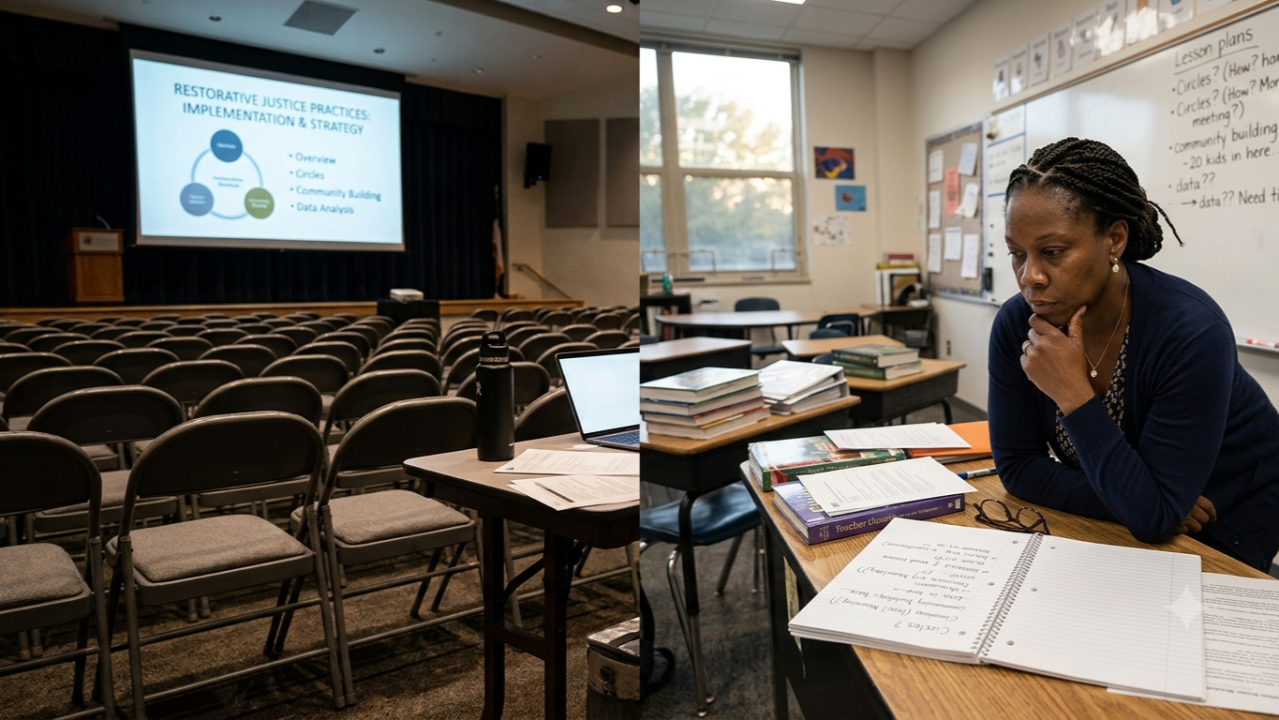
You're sitting in a Tuesday afternoon PD session. A presenter is sharing research on formative assessment. The slides are slick. The research is solid. You take notes. You think, "This would help my students."
The session ends at 3:45. You head back to your classroom, grab your materials, and leave by 4:15.
Two weeks later, you're teaching the same way you always have. The strategies from the PD? You haven't used them. Not because they're bad. But because you haven't actually practiced them. You haven't seen what they look like in your classroom. You haven't worked through the messy part where you try something new and it doesn't quite work.
This is the reality of most professional development. It's an event. Not a practice.
Why Events Don't Create Change
Here's what happens when PD is an event:
You learn something new in isolation. You're away from your classroom, your students, your context. The presenter is speaking to a room of 200 teachers who teach different grades, different subjects, different student populations.
The strategies sound good in theory. But you don't know how they'd work with your fifth graders. Or your high school seniors. Or your students who struggle with reading.
You leave with notes and good intentions. But implementing something new requires practice. Requires making mistakes. Requires adjusting. Requires doing it again and again until it becomes natural.
Events give you information. They don't give you practice.
What Actually Changes Practice
Think about something you're really good at. Teaching a lesson you've taught ten times. Giving feedback on essays. Managing a difficult classroom conversation.
You're good at these things because you've practiced them. You've done them again and again. You've noticed what works. You've adjusted when something didn't work. You've refined over time.
You didn't become good at these things by attending a one-time workshop.
Real change happens through practice. Through trying something. Noticing what happened. Adjusting. Trying again. Getting feedback. Refining.
And this happens not in isolation, but with colleagues. With a team. With a shared vision of what you're trying to accomplish.
Imagine This Instead
You're in your team meeting on Wednesday afternoon. You and your colleagues are looking at student work from yesterday's lessons. You notice that students are answering questions but not really thinking deeply. They're completing assignments, not wrestling with meaningful ideas.
Your team decides: "This month, we're all going to practice one strategy. We're going to use more open ended questions that require deeper thinking. We're going to do this together. We'll teach our lessons, come back together, look at student responses, and figure out what's working."
One teacher volunteers to try it first. She plans a lesson where instead of asking "What is photosynthesis?" she asks "Why do plants need energy? Where does it come from? How is it different from how you get energy?" She teaches the lesson. Students have to think. They have to investigate. They have to discuss.
She comes back to the team. "Here's what I did. Here's what students did. Some of them went really deep. Some of them just gave me surface answers. I'm not sure what I'm doing differently, but I want to keep trying."
Another teacher tries it. She adjusts it based on what she learned from her colleague's experience. She tries it with her students. She notices something slightly different. She comes back and shares.
By week four, all the teachers on the team are practicing the same strategy. They're not all doing it exactly the same way. But they're all focused on the same thing: creating conditions where students think more deeply. And they're all learning together about what works and what doesn't.
This is learning that transfers. Because it's not an event. It's a practice.
Why This Matters for Deep Student Thinking
Remember our definition: effective instruction is measured by how deeply students think every day.
You can't create deeper student thinking by having teachers attend a PD workshop. You create it by having teachers practice together. By having them try something. See it work (or not work). Adjust. Try again. Get feedback. Refine.
It takes time. It's not efficient. But it's how real change happens.
And the LEAD Spark Team platform is designed exactly for this. Not to deliver information about effective teaching. But to support teacher teams as they practice together, reflect on evidence from their classrooms, get meaningful coaching, and refine until it becomes part of the culture.
The Leadership Move
The move is stopping thinking about professional development as something that happens in an event. Start thinking about it as something that happens in your classrooms, with your team, over time.
What if instead of sending teachers to a conference, you used that time for your team to practice together? To look at student work together? To get coached on something you're trying?
What if the goal wasn't for teachers to learn about effective instruction. The goal was for them to practice effective instruction together until it becomes the culture.
The Leadership Pause
Think about a professional development initiative in your school. Is it working? Are you seeing it in classrooms? Or was it an event that came and went?
If it came and went, that's not a failure of the strategy. That's a failure of the structure. Real change requires practice. Not events.
Learn more in Chapter 7 of The Question-Driven Principal: Leading Instructional Improvement Without Being the Content Expert
Further Reading:
Joyce, B., & Showers, B. (2002). Student Achievement Through Staff Development (3rd ed.). Association for Supervision and Curriculum Development. Joyce and Showers' research demonstrates that professional development delivered as one-time workshops rarely transfers to classroom practice. Transfer happens when teachers practice new strategies, get feedback on their practice, and engage in coached practice with colleagues over time.
Guskey, T. R. (2000). Evaluating Professional Development. Corwin Press. Guskey's research on professional development effectiveness shows that one-time training sessions have minimal impact on teacher practice or student learning. Sustained, job-embedded learning with ongoing support and practice is what actually changes teaching and learning.
Join Us at the Spark Curiosity EDU Conference
This July, join educators and leaders from across the country at the Spark Curiosity EDU Conference. We'll explore how to move from professional development events to real learning practices. See how teacher teams practice together, reflect on evidence, and refine until deeper student thinking becomes the expectation in every classroom. Learn alongside Olivia Odileke and the Kampus Insights team.
Visit sparkcuriosityedu.com to register and learn more. Conference takes place at the end of July—the perfect time to design your learning structure for the new school year.
Lead Spark Team
See where your improvement process is actually breaking
In 30 minutes, look at what is working in your school, where walkthroughs and PLCs stop changing practice, and what one focused cycle would look like. No credit card. No prep required.